
AI PROMPT ·
GPT-6 Astra Gear Mechanism Simulation Prompt
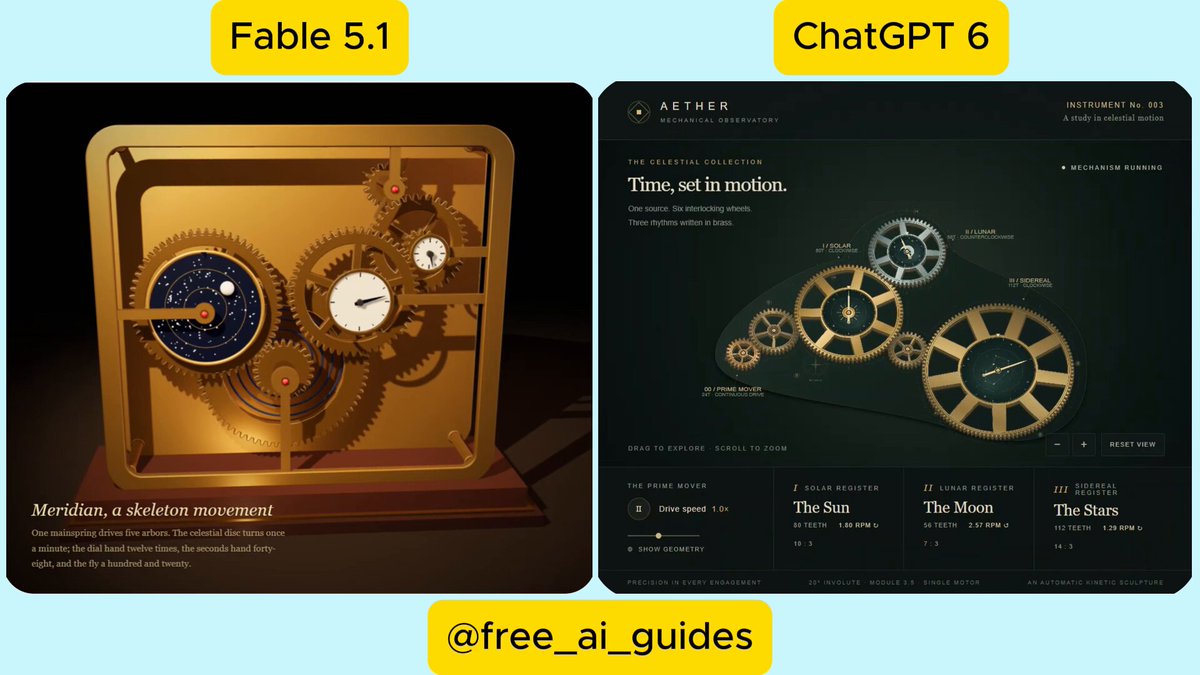
Fable 5.1 and GPT-6 Astra had to build a machine where a 60-tooth gear driving a 20-tooth gear turns it exactly three times faster. In a real mechanism, every gear has to mesh with its neighbor. The teeth need the same size and spacing or they won't fit together, and the speed of each gear comes straight from its tooth count. A gear with 60 teeth driving one with 20 turns it three times faster, no exceptions. That's why it's hard to simulate. You can't spin a few circles and call it clockwork. If the ratios are wrong, teeth pass through each other. If the alignment is off, the gears jam or drift apart, and every mistake shows the moment it starts turning. That's also what makes it a worthy test. Plenty of open builds hide sloppy logic behind nice visuals, and a gear train can't. The look of the mechanism is a free choice, but the meshing either works or it doesn't. The prompt asked for a train of gears driven by a single source, every gear meshing with its neighbors at the correct ratio, teeth aligned, and at least three visible outputs turning at different speeds. Both models got one attempt, no style direction, and no chance to fix anything afterward. You judge which one built the better mechanism.
PROMPT
Fable 5.1 and GPT-6 Astra had to build a machine where a 60-tooth gear driving a 20-tooth gear turns it exactly three times faster. In a real mechanism, every gear has to mesh with its neighbor. The teeth need the same size and spacing or they won't fit together, and the speed of each gear comes straight from its tooth count. A gear with 60 teeth driving one with 20 turns it three times faster, no exceptions. That's why it's hard to simulate. You can't spin a few circles and call it clockwork. If the ratios are wrong, teeth pass through each other. If the alignment is off, the gears jam or drift apart, and every mistake shows the moment it starts turning. That's also what makes it a worthy test. Plenty of open builds hide sloppy logic behind nice visuals, and a gear train can't. The look of the mechanism is a free choice, but the meshing either works or it doesn't. The prompt asked for a train of gears driven by a single source, every gear meshing with its neighbors at the correct ratio, teeth aligned, and at least three visible outputs turning at different speeds. Both models got one attempt, no style direction, and no chance to fix anything afterward. You judge which one built the better mechanism.